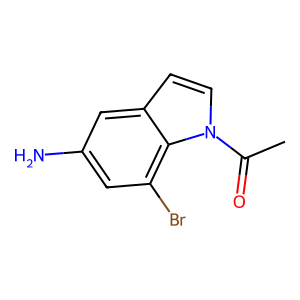
1-(5-amino-7-bromoindol-1-yl)ethanone
CAS No.:
1000343-32-7
M. Wt:
253.095
M. Fa:
C10H9BrN2O
InChI Key:
-
Names and Identifiers of 1-(5-amino-7-bromoindol-1-yl)ethanone
CAS Number |
1000343-32-7 |
|---|---|
IUPAC Name |
1-(5-azanyl-7-bromanyl-indol-1-yl)ethanone |
Canonical SMILES |
CC(=O)N1C=CC2=CC(=CC(=C21)Br)N |
Physical and chemical properties of 1-(5-amino-7-bromoindol-1-yl)ethanone
Boiling Point |
393.6±22.0 °C at 760 mmHg |
|---|---|
Density |
1.7±0.1 g/cm3 |
Exact Mass |
251.989822 |
Flash Point |
191.9±22.3 °C |
Index of Refraction |
1.677 |
LogP |
2.06 |
Molecular Formula |
C10H9BrN2O |
Molecular Weight |
253.095 |
PSA |
48.02000 |
Vapour Pressure |
0.0±0.9 mmHg at 25°C |
Applications of 1-(5-amino-7-bromoindol-1-yl)ethanone
1-(5-Amino-7-bromo-1H-indol-1-yl)ethanone has potential applications in various fields:
- Pharmaceutical Development: Due to its biological activities, it may serve as a lead compound for developing new anticancer or antimicrobial agents.
- Research Tool: This compound can be used in biochemical assays to study enzyme interactions and cellular pathways involving indole derivatives.
Interaction Studies of 1-(5-amino-7-bromoindol-1-yl)ethanone
Interaction studies reveal that 1-(5-Amino-7-bromo-1H-indol-1-yl)ethanone may interact with various biomolecules:
- Enzyme Inhibition: The compound has been shown to inhibit specific enzymes involved in cancer metabolism, suggesting its role as a therapeutic agent.
- Receptor Binding: Preliminary studies indicate potential binding affinity to certain receptors associated with cancer progression and inflammation.
Biological Activity of 1-(5-amino-7-bromoindol-1-yl)ethanone
The biological activity of 1-(5-Amino-7-bromo-1H-indol-1-yl)ethanone is notable, particularly among indole derivatives. These compounds are known for their diverse pharmacological properties, including:
- Anticancer Activity: Indole derivatives have been shown to inhibit cancer cell proliferation through various mechanisms, including apoptosis induction and cell cycle arrest.
- Antimicrobial Properties: Some studies indicate that this compound may exhibit antimicrobial activity against certain bacterial strains.
- Anti-inflammatory Effects: Indole derivatives often show potential in reducing inflammation, making them candidates for treating inflammatory diseases.