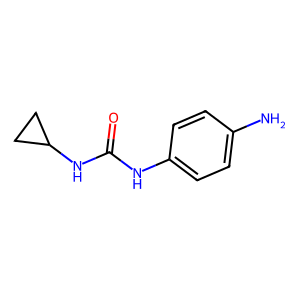
1-(4-Aminophenyl)-3-cyclopropylurea
Names and Identifiers of 1-(4-Aminophenyl)-3-cyclopropylurea
CAS Number |
1000931-26-9 |
|---|---|
MDL Number |
MFCD09802241 |
IUPAC Name |
1-(4-aminophenyl)-3-cyclopropylurea |
InChI |
InChI=1S/C10H13N3O/c11-7-1-3-8(4-2-7)12-10(14)13-9-5-6-9/h1-4,9H,5-6,11H2,(H2,12,13,14) |
InChIKey |
CMXMMZLCDAGGNQ-UHFFFAOYSA-N |
Canonical SMILES |
C1CC1NC(=O)NC2=CC=C(C=C2)N |
UNSPSC Code |
12352100 |
Physical and chemical properties of 1-(4-Aminophenyl)-3-cyclopropylurea
Exact Mass |
191.10600 |
|---|---|
H Bond Acceptors |
2 |
H Bond Donors |
3 |
LogP |
2.59780 |
Molecular Formula |
C10H13N3O |
Molecular Weight |
191.23000 |
PSA |
67.15000 |
Safety Information of 1-(4-Aminophenyl)-3-cyclopropylurea

Applications of 1-(4-Aminophenyl)-3-cyclopropylurea
1-(4-Aminophenyl)-3-cyclopropylurea has potential applications in various fields:
- Pharmaceuticals: Due to its anti-inflammatory and analgesic properties, it could be developed into a therapeutic agent for treating pain and inflammation.
- Agriculture: Its unique structure may offer potential as a pesticide or herbicide, although further studies are needed to explore this application.
- Material Science: The compound's properties may be useful in developing new materials or polymers with specific functionalities.
Interaction Studies of 1-(4-Aminophenyl)-3-cyclopropylurea
Interaction studies involving 1-(4-Aminophenyl)-3-cyclopropylurea focus on its binding affinities with various biological targets. These studies are crucial for understanding its mechanism of action and potential side effects. Research often employs techniques such as:
- Molecular Docking Studies: To predict how well the compound binds to specific enzymes or receptors.
- In Vitro Assays: To evaluate its biological activity against cell lines or isolated proteins.
Biological Activity of 1-(4-Aminophenyl)-3-cyclopropylurea
Research indicates that 1-(4-Aminophenyl)-3-cyclopropylurea exhibits significant biological activities, particularly in the realm of pharmacology. It has been studied for its potential as an anti-inflammatory and analgesic agent due to its structural similarity to known non-steroidal anti-inflammatory drugs (NSAIDs). Additionally, preliminary studies suggest it may have antitumor properties, making it a candidate for further investigation in cancer therapy.
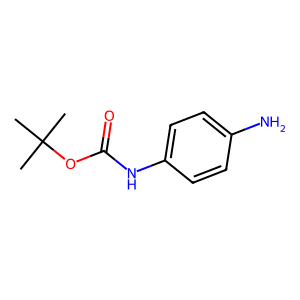 Cas:71026-66-9
