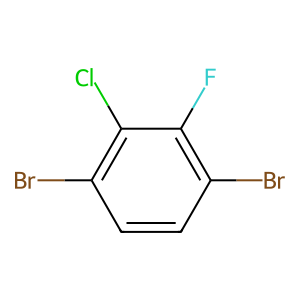
1,4-Dibromo-2-chloro-3-fluorobenzene
CAS No.:
1000573-09-0
M. Wt:
288.33900
M. Fa:
C6H2Br2ClF
InChI Key:
PJTWVACAFWJFAG-UHFFFAOYSA-N
Appearance:
Clear
Names and Identifiers of 1,4-Dibromo-2-chloro-3-fluorobenzene
CAS Number |
1000573-09-0 |
|---|---|
MDL Number |
MFCD09878168 |
IUPAC Name |
1,4-dibromo-2-chloro-3-fluorobenzene |
InChI |
InChI=1S/C6H2Br2ClF/c7-3-1-2-4(8)6(10)5(3)9/h1-2H |
InChIKey |
PJTWVACAFWJFAG-UHFFFAOYSA-N |
Canonical SMILES |
C1=CC(=C(C(=C1Br)F)Cl)Br |
UNSPSC Code |
12352100 |
Physical and chemical properties of 1,4-Dibromo-2-chloro-3-fluorobenzene
Exact Mass |
285.82000 |
|---|---|
LogP |
4.00410 |
Molecular Formula |
C6H2Br2ClF |
Molecular Weight |
288.33900 |
Safety Information of 1,4-Dibromo-2-chloro-3-fluorobenzene

Applications of 1,4-Dibromo-2-chloro-3-fluorobenzene
1,4-Dibromo-2-chloro-3-fluorobenzene finds applications in various fields:
- Chemical Research: Used as an intermediate in the synthesis of more complex organic molecules.
- Pharmaceuticals: Potential precursor for developing new drugs or therapeutic agents due to its unique structural properties.
- Material Science: Utilized in the development of new materials with specific electronic or optical properties.
Interaction Studies of 1,4-Dibromo-2-chloro-3-fluorobenzene
Interaction studies involving 1,4-dibromo-2-chloro-3-fluorobenzene typically focus on its reactivity with nucleophiles and electrophiles. The presence of multiple halogens affects its interaction profile, making it a valuable compound for studying reaction mechanisms in organic chemistry. More detailed studies are needed to assess its interactions with biological systems.