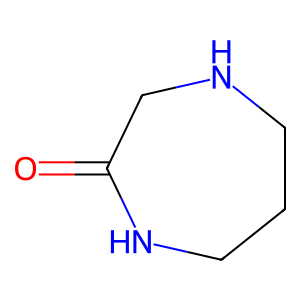
1,4-Diazepan-2-one
CAS No.:
99822-50-1
M. Wt:
114.146
M. Fa:
C5H10N2O
InChI Key:
DRRVROVYLJHJIV-UHFFFAOYSA-N
Appearance:
White Solid
Names and Identifiers of 1,4-Diazepan-2-one
CAS Number |
99822-50-1 |
|---|---|
EC Number |
886-412-9 |
MDL Number |
MFCD06804501 |
IUPAC Name |
1,4-diazepan-2-one |
InChI |
InChI=1S/C5H10N2O/c8-5-4-6-2-1-3-7-5/h6H,1-4H2,(H,7,8) |
InChIKey |
DRRVROVYLJHJIV-UHFFFAOYSA-N |
Canonical SMILES |
C1CNCC(=O)NC1 |
UNSPSC Code |
12352100 |
Physical and chemical properties of 1,4-Diazepan-2-one
Acidity coefficient |
15.88±0.20(Predicted) |
|---|---|
Boiling Point |
308.8±35.0 °C at 760 mmHg |
Density |
1.0±0.1 g/cm3 |
Exact Mass |
114.079315 |
Flash Point |
159.5±26.1 °C |
Index of Refraction |
1.443 |
LogP |
-1.80 |
Melting Point |
86-88 °C(Solv: acetone (67-64-1)) |
Molecular Formula |
C5H10N2O |
Molecular Weight |
114.146 |
PSA |
44.62000 |
Storage condition |
2-8°C |
Vapour Pressure |
0.0±0.7 mmHg at 25°C |
Safety Information of 1,4-Diazepan-2-one

Biological Activity of 1,4-Diazepan-2-one
The biological activity of 1,4-diazepan-2-one is primarily associated with its structural similarity to benzodiazepines, which are known for their anxiolytic, sedative, and muscle relaxant properties. Research indicates that compounds within this class can modulate the gamma-aminobutyric acid (GABA) receptor activity, leading to enhanced inhibitory neurotransmission in the central nervous system.
Studies have shown that derivatives of 1,4-diazepan-2-one exhibit varying degrees of biological activity, including potential antitumor and antimicrobial properties.
Physical sample testing spectrum (NMR) of 1,4-Diazepan-2-one

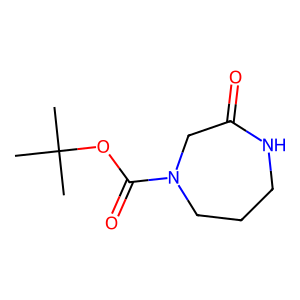 Cas:179686-38-5

 Cas:105-36-2

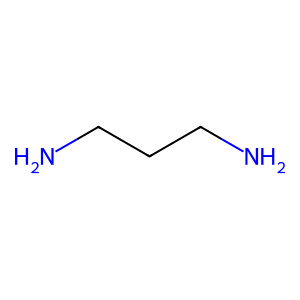 Cas:109-76-2