
1,2-Dibromo-5-fluoro-3-methylbenzene
Names and Identifiers of 1,2-Dibromo-5-fluoro-3-methylbenzene
CAS Number |
1000576-64-6 |
|---|---|
MDL Number |
MFCD09800773 |
IUPAC Name |
1,2-dibromo-5-fluoro-3-methylbenzene |
InChI |
InChI=1S/C7H5Br2F/c1-4-2-5(10)3-6(8)7(4)9/h2-3H,1H3 |
InChIKey |
UVWQDDHNMVVFOR-UHFFFAOYSA-N |
Canonical SMILES |
CC1=CC(=CC(=C1Br)Br)F |
UNSPSC Code |
12352100 |
Physical and chemical properties of 1,2-Dibromo-5-fluoro-3-methylbenzene
Exact Mass |
265.87400 |
|---|---|
LogP |
3.65910 |
Molecular Formula |
C7H5Br2F |
Molecular Weight |
267.92100 |
Safety Information of 1,2-Dibromo-5-fluoro-3-methylbenzene

Applications of 1,2-Dibromo-5-fluoro-3-methylbenzene
1,2-Dibromo-5-fluoro-3-methylbenzene has several applications across various fields:
- Chemical Research: It serves as an intermediate in the synthesis of more complex organic molecules.
- Pharmaceutical Development: Its derivatives may lead to the creation of new therapeutic agents.
- Industrial Use: The compound is utilized in producing specialty chemicals and materials.
Interaction Studies of 1,2-Dibromo-5-fluoro-3-methylbenzene
Interaction studies involving 1,2-dibromo-5-fluoro-3-methylbenzene focus on its reactivity with biological molecules. The unique combination of halogens influences its interaction profile with target proteins or enzymes. Research has shown that halogenated compounds can significantly alter binding affinities and specificities due to their ability to form diverse non-covalent interactions.
Similar CompoundsSeveral compounds share structural similarities with 1,2-dibromo-5-fluoro-3-methylbenzene. Here are some notable examples:
| Compound Name | Structure Characteristics |
|---|---|
| 1,2-Dibromo-4-fluoro-5-methylbenzene | Similar structure but different positions of bromine and fluorine atoms. |
| 1,3-Dibromo-5-fluorobenzene | Lacks the methyl group; different substitution pattern on the benzene ring. |
| 1-Bromo-3-fluoro-5-(trifluoromethyl)benzene | Contains a trifluoromethyl group; different halogen substitution pattern. |
Biological Activity of 1,2-Dibromo-5-fluoro-3-methylbenzene
Research indicates that halogenated compounds like 1,2-dibromo-5-fluoro-3-methylbenzene can exhibit significant biological activity. The presence of halogens often enhances the binding affinity and specificity toward biological targets, such as proteins or enzymes. Interaction studies have shown that compounds with halogen substituents can engage in non-covalent interactions, including hydrogen bonding and hydrophobic interactions, which are crucial for their biological efficacy.
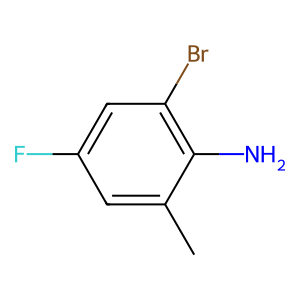 Cas:202865-77-8
