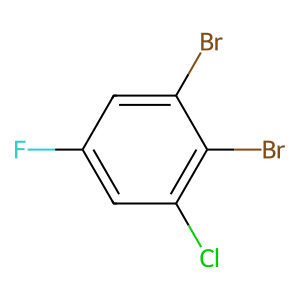
1,2-Dibromo-3-chloro-5-fluorobenzene
Names and Identifiers of 1,2-Dibromo-3-chloro-5-fluorobenzene
CAS Number |
1000577-62-7 |
|---|---|
MDL Number |
MFCD09878108 |
IUPAC Name |
1,2-dibromo-3-chloro-5-fluorobenzene |
InChI |
InChI=1S/C6H2Br2ClF/c7-4-1-3(10)2-5(9)6(4)8/h1-2H |
InChIKey |
VQDBFZZJIYBHCF-UHFFFAOYSA-N |
Canonical SMILES |
C1=C(C=C(C(=C1Cl)Br)Br)F |
UNSPSC Code |
12352100 |
Physical and chemical properties of 1,2-Dibromo-3-chloro-5-fluorobenzene
Exact Mass |
285.82000 |
|---|---|
LogP |
4.00410 |
Molecular Formula |
C6H2Br2ClF |
Molecular Weight |
288.33900 |
Safety Information of 1,2-Dibromo-3-chloro-5-fluorobenzene

Applications of 1,2-Dibromo-3-chloro-5-fluorobenzene
1,2-Dibromo-3-chloro-5-fluorobenzene is widely used in various applications:
- Organic Synthesis: It acts as an important building block for synthesizing more complex organic molecules.
- Pharmaceuticals: Its unique structure allows for modifications that can lead to novel pharmaceutical compounds.
- Agrochemicals: The compound may also find applications in developing agrochemicals due to its reactivity and biological activity.
Interaction Studies of 1,2-Dibromo-3-chloro-5-fluorobenzene
Interaction studies have highlighted the compound's role as an inhibitor of specific cytochrome P450 enzymes. These interactions can influence drug metabolism and efficacy, making it crucial for evaluating potential drug candidates that may interact with this compound. Understanding these interactions aids in predicting pharmacokinetic properties and potential side effects when used in therapeutic contexts.
Biological Activity of 1,2-Dibromo-3-chloro-5-fluorobenzene
The biological activity of 1,2-dibromo-3-chloro-5-fluorobenzene has been studied with respect to its potential as a pharmaceutical agent. It has shown inhibitory effects on certain cytochrome P450 enzymes, specifically CYP1A2 and CYP2C9, indicating possible interactions with metabolic pathways in organisms. These properties suggest that this compound may be relevant in drug development and toxicological studies due to its influence on drug metabolism.