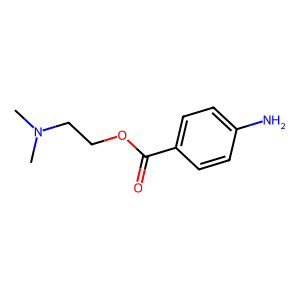
(Dimethylamino)ethyl p-aminobenzoate
CAS No.:
10012-47-2
M. Wt:
208.257
M. Fa:
C11H16N2O2
InChI Key:
MXBCQLLLJGRMJI-UHFFFAOYSA-N
Names and Identifiers of (Dimethylamino)ethyl p-aminobenzoate
CAS Number |
10012-47-2 |
|---|---|
IUPAC Name |
2-(dimethylamino)ethyl 4-aminobenzoate |
InChI |
InChI=1S/C11H16N2O2/c1-13(2)7-8-15-11(14)9-3-5-10(12)6-4-9/h3-6H,7-8,12H2,1-2H3 |
InChIKey |
MXBCQLLLJGRMJI-UHFFFAOYSA-N |
Canonical SMILES |
CN(C)CCOC(=O)C1=CC=C(C=C1)N |
Physical and chemical properties of (Dimethylamino)ethyl p-aminobenzoate
Boiling Point |
346.6±22.0 °C at 760 mmHg |
|---|---|
Density |
1.1±0.1 g/cm3 |
Exact Mass |
208.121185 |
Flash Point |
163.4±22.3 °C |
Index of Refraction |
1.556 |
LogP |
1.30 |
Molecular Formula |
C11H16N2O2 |
Molecular Weight |
208.257 |
PSA |
55.56000 |
Vapour Pressure |
0.0±0.8 mmHg at 25°C |
Applications of (Dimethylamino)ethyl p-aminobenzoate
Dimethylprocaine is primarily used in:
- Medical Anesthesia: As a local anesthetic in various minor surgical and dental procedures.
- Research Settings: Investigating its pharmacological properties and potential therapeutic applications.
- Veterinary Medicine: Employed for local anesthesia in animals during surgeries.
Interaction Studies of (Dimethylamino)ethyl p-aminobenzoate
Research has shown that dimethylprocaine interacts with various biological systems:
- Centrally Acting Stimulants: It has been studied for its reinforcing effects similar to cocaine, indicating potential abuse liability.
- Pharmacokinetic Interactions: Dimethylprocaine may interact with other medications metabolized by similar pathways, affecting their efficacy and safety profiles.
Biological Activity of (Dimethylamino)ethyl p-aminobenzoate
Dimethylprocaine exhibits significant biological activity as a local anesthetic. Its mechanism of action involves:
- Sodium Channel Blockade: By binding to the voltage-gated sodium channels in neuronal membranes, dimethylprocaine prevents depolarization and subsequent nerve impulse conduction.
- Analgesic Effects: It provides effective pain relief during minor surgical procedures and dental work.
- Reinforcing Properties: Studies indicate that dimethylprocaine may have stimulant effects in animal models, similar to those observed with other local anesthetics like cocaine.
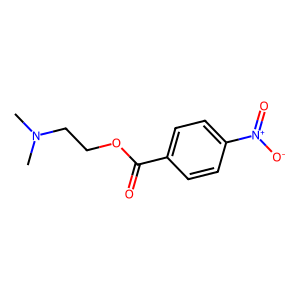 Cas:38152-22-6

 Cas:54288-75-4
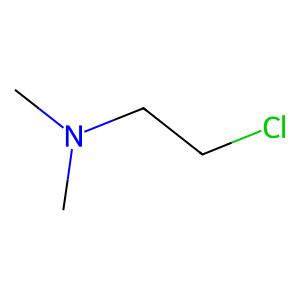 Cas:107-99-3

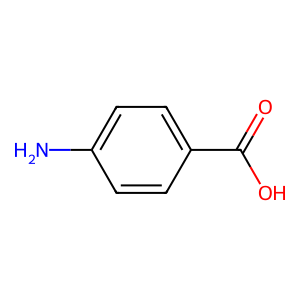 Cas:150-13-0