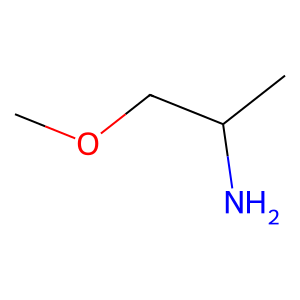
(2R)-1-methoxypropan-2-amine
Names and Identifiers of (2R)-1-methoxypropan-2-amine
CAS Number |
99636-38-1 |
|---|---|
EC Number |
620-037-1 |
IUPAC Name |
(2R)-1-methoxypropan-2-amine |
InChI |
InChI=1S/C4H11NO/c1-4(5)3-6-2/h4H,3,5H2,1-2H3/t4-/m1/s1 |
InChIKey |
NXMXETCTWNXSFG-SCSAIBSYSA-N |
Canonical SMILES |
CC(COC)N |
Isomeric SMILES |
C[C@H](COC)N |
Physical and chemical properties of (2R)-1-methoxypropan-2-amine
Acidity coefficient |
8.84±0.10(Predicted) |
|---|---|
Boiling Point |
93.7±0.0 °C at 760 mmHg |
Density |
0.8±0.1 g/cm3 |
Exact Mass |
89.084061 |
Flash Point |
8.9±0.0 °C |
Index of Refraction |
1.407 |
LogP |
-0.31 |
Molecular Formula |
C4H11NO |
Molecular Weight |
89.136 |
PSA |
35.25000 |
Vapour Pressure |
48.9±0.1 mmHg at 25°C |
Safety Information of (2R)-1-methoxypropan-2-amine


Applications of (2R)-1-methoxypropan-2-amine
(2R)-1-methoxypropan-2-amine has diverse applications across several fields:
- Chemical Industry: It serves as a chiral building block for synthesizing complex molecules.
- Pharmaceuticals: The compound is a precursor for various pharmaceuticals, particularly in the synthesis of herbicides.
- Agrochemicals: It is crucial for producing specific enantiomers used in herbicides.
- Detection Technologies: Polymeric probes incorporating this compound have shown potential for colorimetric detection of nerve agent mimics.
Interaction Studies of (2R)-1-methoxypropan-2-amine
The interaction of (2R)-1-methoxypropan-2-amine with biological systems has been studied primarily concerning its role as a chiral building block in agrochemicals. Its mechanism of action involves binding to specific receptors or enzymes, influencing their activity. For instance, the (S)-enantiomer exhibits predominant activity in certain herbicidal applications, highlighting the importance of stereochemistry in its biological function.
Biological Activity of (2R)-1-methoxypropan-2-amine
The biological activity of (2R)-1-methoxypropan-2-amine is significant due to its chiral nature, which allows it to interact selectively with biological targets such as enzymes and receptors. It may act as an agonist or antagonist at specific receptor sites, modulating biochemical pathways. This compound has been identified as a key building block in the synthesis of herbicides like metolachlor and dimethenamid, which are widely used in agriculture.
Physical sample testing spectrum (NMR) of (2R)-1-methoxypropan-2-amine

 Cas:107-98-2

 Cas:5878-19-3