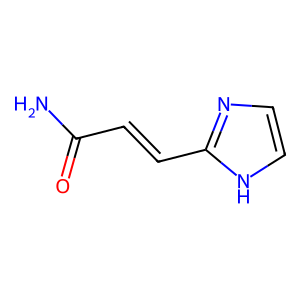
(2E)-3-(1H-imidazol-2-yl)prop-2-enamide
Names and Identifiers of (2E)-3-(1H-imidazol-2-yl)prop-2-enamide
CAS Number |
1000568-69-3 |
|---|---|
EC Number |
947-246-3 |
IUPAC Name |
(E)-3-(1H-imidazol-2-yl)prop-2-enamide |
InChI |
InChI=1S/C6H7N3O/c7-5(10)1-2-6-8-3-4-9-6/h1-4H,(H2,7,10)(H,8,9)/b2-1+ |
InChIKey |
PCLRNQYQHPROMR-OWOJBTEDSA-N |
Canonical SMILES |
C1=CN=C(N1)C=CC(=O)N |
Isomeric SMILES |
C1=CN=C(N1)/C=C/C(=O)N |
Physical and chemical properties of (2E)-3-(1H-imidazol-2-yl)prop-2-enamide
Molecular Formula |
C6H7N3O |
|---|---|
Molecular Weight |
137.14 |
Safety Information of (2E)-3-(1H-imidazol-2-yl)prop-2-enamide

Applications of (2E)-3-(1H-imidazol-2-yl)prop-2-enamide
The potential applications of (2E)-3-(1H-imidazol-2-yl)prop-2-enamide span various fields:
- Pharmaceuticals: Due to its biological activity, it may serve as a lead compound for developing new drugs targeting infections or cancer.
- Agricultural Chemicals: Its antimicrobial properties could be harnessed in developing pesticides or fungicides.
- Material Science: The compound may find utility in creating polymers or materials with specific properties due to its structural characteristics.
Interaction Studies of (2E)-3-(1H-imidazol-2-yl)prop-2-enamide
Interaction studies involving (2E)-3-(1H-imidazol-2-yl)prop-2-enamide typically focus on its binding affinity to biological targets such as enzymes or receptors. Techniques such as surface plasmon resonance (SPR) or isothermal titration calorimetry (ITC) can provide insights into the kinetics and thermodynamics of these interactions. Additionally, studies assessing its effects on cellular signaling pathways are crucial for understanding its mechanism of action.
Biological Activity of (2E)-3-(1H-imidazol-2-yl)prop-2-enamide
Research indicates that compounds with imidazole rings often exhibit significant biological activity. For instance, imidazole derivatives have been shown to possess antimicrobial, anti-inflammatory, and anticancer properties. The biological activity of (2E)-3-(1H-imidazol-2-yl)prop-2-enamide may be assessed through various assays that measure its effects on cellular pathways and transcription factors. Studies suggest that compounds similar to this one can modulate gene expression and influence metabolic pathways, making them valuable in drug discovery.