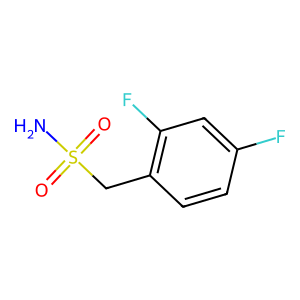
(2,4-Difluorophenyl)methanesulfonamide
Names and Identifiers of (2,4-Difluorophenyl)methanesulfonamide
CAS Number |
1001026-56-7 |
|---|---|
MDL Number |
MFCD09800677 |
IUPAC Name |
(2,4-difluorophenyl)methanesulfonamide |
InChI |
InChI=1S/C7H7F2NO2S/c8-6-2-1-5(7(9)3-6)4-13(10,11)12/h1-3H,4H2,(H2,10,11,12) |
InChIKey |
FBBNILYZNGQNAM-UHFFFAOYSA-N |
Canonical SMILES |
C1=CC(=C(C=C1F)F)CS(=O)(=O)N |
UNSPSC Code |
12352100 |
Physical and chemical properties of (2,4-Difluorophenyl)methanesulfonamide
Exact Mass |
207.01700 |
|---|---|
LogP |
2.53440 |
Molecular Formula |
C7H7F2NO2S |
Molecular Weight |
207.19800 |
PSA |
68.54000 |
Safety Information of (2,4-Difluorophenyl)methanesulfonamide

Applications of (2,4-Difluorophenyl)methanesulfonamide
(2,4-Difluorophenyl)methanesulfonamide finds applications in various domains:
- Pharmaceuticals: Due to its potential anti-inflammatory properties, it is being explored as a lead compound for developing new therapeutic agents targeting inflammatory diseases.
- Material Science: Its unique electronic properties make it a candidate for use in advanced materials and organic electronics.
- Chemical Research: It serves as an important intermediate in the synthesis of more complex organic compounds.
Interaction Studies of (2,4-Difluorophenyl)methanesulfonamide
Studies investigating the interactions of (2,4-Difluorophenyl)methanesulfonamide with biological targets have shown promising results. Its ability to selectively inhibit COX-2 over COX-1 suggests a reduced risk of gastrointestinal side effects commonly associated with non-selective NSAIDs. Additionally, molecular docking studies indicate favorable binding affinities to target proteins involved in inflammatory pathways.
Biological Activity of (2,4-Difluorophenyl)methanesulfonamide
The biological activity of (2,4-Difluorophenyl)methanesulfonamide has been explored in various studies. Compounds containing methanesulfonamide groups are known for their potential as anti-inflammatory agents and have been investigated for their effects on cyclooxygenase enzymes, particularly COX-2, which is involved in inflammation pathways. The difluorinated structure may enhance its selectivity and potency compared to non-fluorinated analogs.