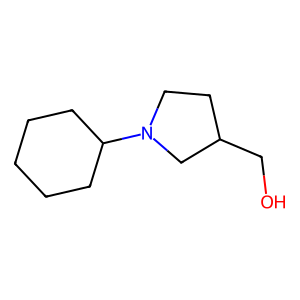
(1-Cyclohexylpyrrolidin-3-yl)methanol
CAS No.:
100049-71-6
M. Wt:
183.29100
M. Fa:
C11H21NO
InChI Key:
UQWOCKWHWBXITR-UHFFFAOYSA-N
Names and Identifiers of (1-Cyclohexylpyrrolidin-3-yl)methanol
CAS Number |
100049-71-6 |
|---|---|
IUPAC Name |
(1-cyclohexylpyrrolidin-3-yl)methanol |
InChI |
InChI=1S/C11H21NO/c13-9-10-6-7-12(8-10)11-4-2-1-3-5-11/h10-11,13H,1-9H2 |
InChIKey |
UQWOCKWHWBXITR-UHFFFAOYSA-N |
Canonical SMILES |
C1CCC(CC1)N2CCC(C2)CO |
Physical and chemical properties of (1-Cyclohexylpyrrolidin-3-yl)methanol
Acidity coefficient |
14.93±0.10(Predicted) |
|---|---|
Boiling Point |
260.1ºC at 760 mmHg |
Density |
1.027g/cm3 |
Exact Mass |
183.16200 |
Flash Point |
102.9ºC |
Index of Refraction |
1.516 |
LogP |
1.57120 |
Molecular Formula |
C11H21NO |
Molecular Weight |
183.29100 |
PSA |
23.47000 |
Vapour Pressure |
0.00181mmHg at 25°C |
Applications of (1-Cyclohexylpyrrolidin-3-yl)methanol
(1-Cyclohexylpyrrolidin-3-yl)methanol has various applications in:
- Organic Synthesis: It serves as a reagent in synthetic pathways due to its functional groups.
- Medicinal Chemistry: Its potential biological activity makes it a subject of interest for developing new therapeutics targeting neurological conditions.
- Research: Used in proteomics and other biochemical studies to explore protein interactions and functions.
Biological Activity of (1-Cyclohexylpyrrolidin-3-yl)methanol
Research indicates that (1-cyclohexylpyrrolidin-3-yl)methanol exhibits significant biological activity, particularly in the context of neuropharmacology. Its structural features suggest potential interactions with neurotransmitter systems, making it a candidate for further investigation in drug discovery. Preliminary studies may point toward its effects on central nervous system pathways, although detailed pharmacological profiles are still needed.